
Chapter One: The Mysterious Recipe
Once upon a time, in a small village surrounded by beautiful green hills and peaceful forests, there lived a young woman named Emma. She was curious, kindhearted, and passionate about discovering natural ways to take care of herself and her family.
Emma lived in a cozy little house with her grandmother, Rose, who was famous throughout the village for her traditional recipes. Her grandmother knew how to prepare delicious soups, homemade bread, herbal teas, and many other dishes that had been passed down through generations.
Every evening, Emma and her grandmother sat together in the kitchen, sharing stories while preparing dinner. The kitchen was always filled with wonderful aromas, from freshly baked bread to warm cinnamon tea.
One cold winter evening, Emma returned home after a long day at work. The wind was blowing strongly, and the temperature had dropped considerably. She removed her coat, sat beside the fireplace, and wrapped herself in a warm blanket.
“Grandma,” she said, “the weather is becoming colder every day. Everyone seems to be talking about traditional remedies for the winter season. Do you know any interesting recipes that people used in the past?”
Her grandmother smiled and opened an old wooden cupboard.
“My dear Emma,” she replied, “there are many traditional recipes that our ancestors prepared with simple ingredients. Some were created to provide comfort during cold evenings, while others became part of family traditions.”
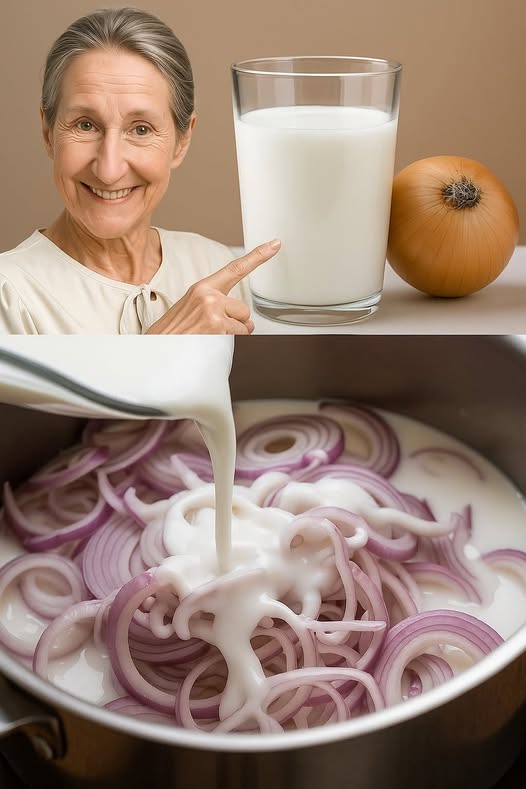
She took out a small onion and a bottle of milk.
Emma stared at the ingredients in surprise.
“An onion and milk? What are you going to make with those?”
Her grandmother laughed gently.
“Something unusual, but very interesting. Today, I will tell you the story of onion cooked in milk.”
Emma moved closer to the kitchen table. She had heard about onion soup and onion sauce, but she had never imagined combining onions with milk to make a warm drink.
She was eager to discover the secret behind this ancient recipe.
Chapter Two: A Tradition Passed Down Through Generations
Grandmother Rose sat beside Emma and began telling her a story about her own childhood.
“When I was a little girl,” she explained, “my grandmother used to prepare warm drinks and simple meals whenever the weather became cold. She believed that the kitchen was one of the most important places in a home because it brought people together.”
Emma listened carefully.
“One evening, when I was about your age, I visited her during the winter holidays. I remember walking into her kitchen and finding a small saucepan on the stove. Inside it, she was gently cooking chopped onions in milk.”
“What did it taste like?” Emma asked.
“That was exactly what I wanted to know!” Rose replied, laughing. “At first, I thought the combination sounded strange. But my grandmother explained that cooking the onion slowly softened its sharp flavor and made the milk aromatic.”
She continued describing the old kitchen, the wooden shelves, and the small window overlooking a garden covered in frost.
Her grandmother had explained that onions were common ingredients in traditional cooking because they were affordable, easy to find, and full of flavor. Milk, meanwhile, provided protein and calcium and could be used to prepare comforting warm foods.
Over time, some families began treating onion milk as a traditional home remedy during the cold season.
“People often passed these recipes from parents to children,” Rose explained. “But we must remember that a family tradition is not automatically a scientifically proven treatment. Some recipes may feel comforting without actually curing an illness.”
Emma nodded thoughtfully.
She realized that traditional recipes carried more than ingredients and instructions. They also preserved memories, family customs, and the experiences of previous generations.
“Can you teach me how to prepare it?” she asked.
“Of course,” her grandmother answered. “Let us begin.”
Chapter Three: The Five-Minute Preparation
Grandmother Rose washed her hands and cleaned the kitchen counter. She placed a medium-sized onion, a cup of milk, a small saucepan, a wooden spoon, and a strainer on the table.
Emma watched as her grandmother peeled the onion and cut it into small pieces.
“Why do we cut the onion into small pieces?” Emma asked.
“Smaller pieces soften more easily during cooking,” Rose explained. “They also release their flavor into the milk.”
Next, she poured the milk into the saucepan and added the chopped onion.
Emma stirred the mixture gently.
Grandmother Rose placed the saucepan over the stove and heated it carefully. As the milk warmed, the kitchen began to fill with the distinctive aroma of cooked onion.
At first, Emma wrinkled her nose.
“I’m not sure I like that smell,” she admitted.
Her grandmother smiled.
“Not every unusual recipe becomes everyone’s favorite. The important thing is to understand how the ingredients work together and decide whether you enjoy the result.”
When the milk began to simmer, Rose lowered the heat. She explained that the mixture should be cooked gently for approximately ten to fifteen minutes, with occasional stirring, rather than being allowed to boil over.
Emma stood beside the stove and watched the onion pieces gradually become softer.
The milk changed slightly in aroma, and the sharp smell of the raw onion became more mellow.
After the cooking was complete, Rose turned off the heat and allowed the mixture to cool a little. She then strained out the onion pieces, leaving the warm milk in a clean cup.
“For a little extra flavor, some people add a small amount of honey or a pinch of turmeric,” she explained. “But these additions are optional.”
Emma looked at the cup.
“So, the recipe is really that simple?”
“Yes,” Rose replied. “A medium onion, one cup of milk, and a little patience.”
Emma took a cautious sip.
The flavor was unusual, slightly sweet, creamy, and unmistakably onion-like.
She laughed.
“I don’t think I have ever tasted anything quite like this!”
Her grandmother laughed with her.
Sometimes, the most memorable kitchen experiences came from trying something new.
Chapter Four: Understanding the Ingredients
The following morning, Emma decided to learn more about the ingredients in the recipe.
She opened her laptop and began reading about onions and milk.
She discovered that onions contained several plant compounds, including quercetin and sulfur-containing compounds. These substances had attracted scientific interest because of their biological properties.
However, Emma also learned that studying a compound in a laboratory did not automatically prove that eating a particular recipe could treat a medical condition.
She wrote this observation in her notebook.
Next, she researched milk. She learned that cow’s milk could provide protein, calcium, and other nutrients. Fortified plant-based alternatives could also provide certain nutrients, although their nutritional content depended on the product.
Emma realized that the combination could be viewed as a simple food preparation rather than a miracle medicine.
She also discovered that not everyone could tolerate every type of milk. People with milk allergies needed to avoid the relevant milk proteins, while those with lactose intolerance might need a suitable lactose-free option or another alternative.
When she shared her discoveries with her grandmother, Rose was delighted.
“You are becoming a thoughtful learner,” she said.
Emma smiled.
“I still enjoy traditional recipes, Grandma. I just want to understand which claims are supported by evidence.”
“That is a wonderful approach,” Rose replied. “We can respect our traditions while remaining curious and careful.”
Emma added another sentence to her notebook:
“A natural ingredient can be nutritious without being a cure for every illness.”
It was a simple lesson, but she knew it would help her make better decisions in the future.
Chapter Five: A Cold Evening and a Warm Cup
A few days later, the village experienced an especially cold evening.
Rain tapped against the windows, and the wind moved through the trees. Emma returned from work feeling tired and uncomfortable.
Her throat felt irritated, and she wanted something warm to drink.
Grandmother Rose was preparing dinner when she noticed Emma entering the kitchen.
“You look tired, my dear,” she said. “Would you like some warm honey water?”
Emma smiled.
“That sounds wonderful. I was also thinking about the onion milk we prepared the other day.”
Rose nodded.
“If you enjoy it, you may have it as a food preparation, provided the ingredients are suitable for you. But we should not assume it treats the cause of your symptoms.”
Together, they prepared a small cup of onion milk, heating the ingredients carefully.
While they waited, Rose prepared another warm drink with honey.
Emma chose the honey drink because she preferred its flavor when her throat felt irritated.
She sat beside the fireplace and drank slowly.
The warmth felt comforting, and she relaxed as she listened to the rain outside.
Her grandmother brought a soft blanket and placed it over her shoulders.
“Sometimes, comfort comes from the simplest things,” Rose said.
Emma agreed.
She realized that the warm drink, the quiet room, and the care of her grandmother all contributed to making the evening more pleasant.
She also understood that if her symptoms became severe, persisted, or were accompanied by difficulty breathing or other concerning signs, she would need appropriate medical attention rather than relying on a home remedy.
That evening, Emma went to bed early and allowed herself time to rest.
Chapter Six: The Village Herbalist
The following week, Emma visited a small shop near the village market. The shop belonged to an elderly woman named Mrs. Clara, who sold herbs, spices, teas, and cooking ingredients.
The shelves were filled with glass jars containing cinnamon sticks, dried mint, ginger, chamomile, and many other familiar ingredients.
Emma greeted Mrs. Clara and asked her about onion milk.
“I learned to prepare it from my grandmother,” Emma explained. “Some people say it can help with coughing, breathing problems, digestion, and even sleep. I would like to know whether those claims are true.”
Mrs. Clara listened carefully.
“Onion milk is an old-fashioned recipe in some families,” she said. “People may find warm drinks soothing, and honey has some evidence of helping relieve cough symptoms in certain circumstances. But that does not prove that onion milk treats asthma, bronchitis, infections, or other diseases.”
Emma appreciated the honest answer.
Mrs. Clara continued, “For example, asthma can be serious and may require prescribed treatment. A homemade drink should never replace an inhaler or other medical care recommended by a healthcare professional.”
Emma wrote down the information.
She also asked whether onion milk could reduce joint pain or cure insomnia.
Mrs. Clara shook her head.
“There is not strong clinical evidence that drinking onion milk provides those specific benefits. Onions contain interesting plant compounds, but we cannot assume that a cooked onion drink will relieve arthritis or act as a proven sleep medicine.”
Emma thanked her for the explanation.
As she walked home, she felt glad that she had asked questions instead of simply believing every claim she had encountered online.
She had learned that trustworthy advice did not need to promise miraculous results.
Chapter Seven: The Family Dinner
One Saturday evening, Emma’s family gathered for dinner.
Her uncle Peter, her aunt Sophie, and several cousins arrived carrying homemade dishes and fresh bread. The house quickly filled with conversation and laughter.
After dinner, Emma told everyone about the unusual recipe she had learned from her grandmother.
Her uncle looked surprised.
“Onion cooked in milk? I have heard of onion soup, but never a drink like that!”
Emma explained the preparation process, describing how the onion was peeled, chopped, and gently simmered in milk for ten to fifteen minutes.
Her aunt Sophie was curious.
“Does it really help people sleep better?” she asked.
Emma answered carefully.
“Some people enjoy warm drinks before bed because they find them relaxing. But there is not reliable evidence that onion milk itself is a treatment for insomnia.”
Her grandmother smiled proudly.
Emma continued explaining that onions and milk could contribute nutrients to a person’s diet, but the recipe could not guarantee stronger immunity or cure respiratory and digestive illnesses.
Her family listened with interest.
Her younger cousin, Oliver, raised his hand playfully.
“So, if I drink onion milk every night, will I never catch a cold again?”
Everyone laughed.
Emma shook her head.
“No! We still need good hygiene, adequate sleep, balanced nutrition, and appropriate medical care. One recipe cannot protect us from every illness.”
Oliver nodded seriously.
“Then I think I will stick to your grandmother’s vegetable soup!”
The family laughed again.
The evening became a wonderful reminder that food could bring people together, even when the recipes were unusual.
Chapter Eight: The Importance of a Healthy Lifestyle
As the winter continued, Emma became increasingly interested in the relationship between food and general well-being.
She began preparing more meals at home and experimenting with vegetables, beans, whole grains, and different sources of protein.
She included onions and garlic in soups and stews because she enjoyed their flavor. She drank milk when she wanted it and chose other suitable beverages when she preferred something different.
She also started walking for twenty minutes after work.
At first, she found it difficult to maintain the routine because her job left her tired. However, she gradually learned to plan her evenings more carefully.
She went to bed at a more regular time, limited late-night screen use, and made room for activities that helped her relax.
One evening, her grandmother noticed her preparing a vegetable soup.
“You seem to have developed a new interest in healthy living,” Rose said.
Emma smiled.
“I used to look for one special ingredient that would solve every problem. Now I understand that well-being depends on many things working together.”
Her grandmother nodded.
“Exactly. Food is important, but so are sleep, movement, emotional well-being, and seeking medical advice when necessary.”
Emma realized that no single recipe needed to carry the responsibility of keeping her healthy.
She could enjoy traditional foods while also developing practical habits that supported her overall well-being.
This discovery gave her a greater sense of confidence and freedom.
Chapter Nine: A Recipe Book Full of Memories
Several months later, Emma decided to create a recipe book for her family.
She chose a beautiful notebook with a green cover and titled it Grandmother’s Kitchen: Recipes, Stories, and Lessons.
Inside, she recorded recipes for vegetable soup, homemade bread, ginger tea, lemon water, and onion cooked in milk.
But she did not write only the ingredients and instructions. She also included the stories behind each recipe.
Beside the onion milk recipe, she described the cold winter evening when her grandmother first introduced it to her.
She wrote about the aroma that filled the kitchen, the sound of rain against the windows, and the laughter they shared when she tasted the unusual drink for the first time.
She also included a note explaining that the recipe was a traditional food preparation, not a proven cure for coughs, asthma, infections, arthritis, digestive disorders, or insomnia.
Her grandmother read the pages slowly.
When she reached the end, her eyes filled with happy tears.
“You have preserved more than recipes,” she whispered. “You have preserved our memories.”
Emma hugged her.
“I want future generations to know where these traditions came from. I also want them to understand how to use information responsibly.”
Grandmother Rose smiled.
“Then you have created something truly valuable.”
The notebook became a treasured family possession. Whenever someone tried a new recipe, they added a note about its flavor, preparation, and the memories it created.
The family learned that traditions did not need exaggerated health claims to remain meaningful.
Sometimes, their greatest value came from the stories they carried.
Chapter Ten: The Secret of the Simple Remedy
Years passed, and Emma became known among her friends as someone who enjoyed cooking and sharing thoughtful advice about food.
Whenever people asked her about onion milk, she told them the story of her grandmother and the winter evening that had begun her journey of discovery.
She explained that onion cooked in milk was simple to prepare: one medium onion, one cup of milk, and gentle simmering for approximately ten to fifteen minutes.
She told them that some people enjoyed the warm preparation as part of their traditional routines, but scientific evidence did not establish it as a treatment for most of the conditions commonly attributed to it.
She also reminded them to use suitable ingredients, prepare food hygienically, refrigerate leftovers promptly, and avoid consuming anything that had spoiled.
Most importantly, she encouraged people to seek professional medical advice when symptoms were serious or persistent.
One evening, Emma visited her grandmother’s garden. The sun was setting behind the hills, painting the sky with beautiful shades of orange and pink.
She sat beside Rose beneath an old apple tree.
“Grandma,” Emma said, “do you remember the first time you showed me onion milk?”
Rose laughed softly.
“Of course. You looked at the onion and milk as if I were about to invent the strangest dish in the world!”
Emma laughed too.
“I thought I was discovering a miracle remedy. Instead, I discovered the importance of asking questions, learning from others, and understanding the difference between tradition and scientific evidence.”
Her grandmother gently held her hand.
“That is the real gift of knowledge, my dear. It helps us appreciate the past while making thoughtful decisions for the future.”
Emma looked toward the little house where so many family meals had been prepared.
She realized that the true secret of onion milk had never been a hidden power to cure every illness.
Its deeper meaning was found in the warmth of the kitchen, the love of her grandmother, the curiosity that encouraged her to learn, and the wisdom to recognize the limits of what a home remedy could do.
From that day forward, Emma continued collecting recipes and stories, preserving the traditions that brought her family together while encouraging everyone to make informed decisions about their health.
And whenever she prepared a warm drink on a cold evening, she remembered that some of life’s most valuable lessons began with the simplest ingredients.
The End.
Moral of the Story
Traditional recipes can preserve family memories and offer comfort, but they should not be confused with proven medical treatments. Onion cooked in milk can be enjoyed as a food preparation by people who tolerate its ingredients, yet claims that it cures respiratory illnesses, improves immunity, treats arthritis, or eliminates insomnia are not well established. True well-being comes from informed choices, balanced nutrition, healthy daily habits, and appropriate medical care.