
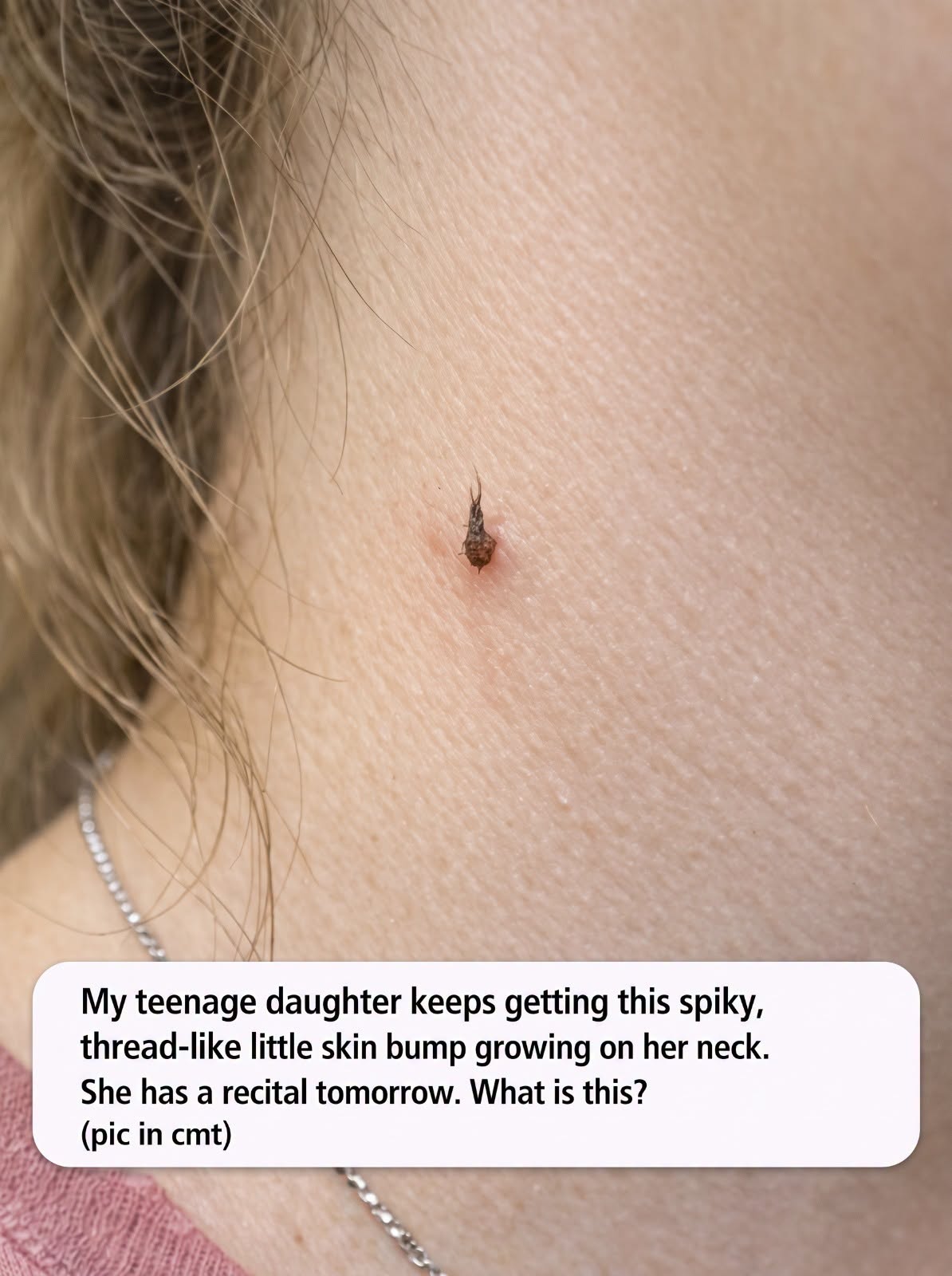
- Flesh-colored
- Pink
- Tan
- Slightly darker than surrounding skin
- Smooth or somewhat rough
- Narrow and elongated
- Single or present in a small cluster
They may be painless, although rubbing or catching the growth on clothing or jewelry can make it irritated.
Why Can a Bump Appear on the Neck?
The neck experiences quite a bit of everyday friction.
Think about everything that touches it during a normal day:
- Shirt collars
- Costume necklines
- Scarves
- Necklace chains
- Hair
- Backpack straps
- Sweat
- Sports equipment
For a teenager involved in dance, theater, choir, sports, or other activities, there may be even more repeated contact.
Friction doesn’t cause a wart, but it can make an existing skin growth easier to notice or cause it to become irritated.
That’s particularly important before a recital, when costume fabric and accessories may repeatedly brush against the area.
Filiform Wart vs. Skin Tag
One of the common look-alikes is a skin tag.
Skin tags are generally soft, smooth growths that hang from the skin by a narrow stalk. They can be flesh-colored or slightly darker and are usually harmless.
A filiform wart, on the other hand, tends to have a more narrow, pointed, or thread-like appearance.
A Skin Tag May Look:
- Soft
- Smooth
- Floppy
- Teardrop-shaped
- Attached by a thin stalk
A Filiform Wart May Look:
- Thin
- Pointed
- Finger-like
- Thread-like
- Slightly rough or irregular
There can be overlap, though, which is why looking at a description isn’t enough to confidently identify a particular growth.
Could It Be a Pimple?
It could be—but the appearance is usually different.
A pimple often has a broader, inflamed base and may be red, tender, swollen, or contain a white or yellow center.
A filiform wart typically looks more like a small projection from the skin rather than a traditional round or inflamed blemish.
An ingrown hair is another possibility, particularly if the bump is near a hair-bearing area.
An ingrown hair may cause redness and tenderness around a trapped hair follicle.