
Chapter One: The Little Village and the Wise Grandmother
Once upon a time, in a peaceful village surrounded by green fields, tall trees, and beautiful gardens, there lived a young woman named Lily. She was a kind, curious, and hardworking girl who loved learning about nature and discovering traditional recipes.
Lily lived with her grandmother, Margaret, in a small house with white walls and a red roof. Behind the house was a wonderful garden filled with flowers, herbs, vegetables, and fruit trees. Every morning, Lily helped her grandmother water the plants, collect vegetables, and prepare delicious meals for the family.
Her grandmother was famous throughout the village for her knowledge of traditional cooking and home remedies. Whenever someone needed advice about preparing a warm drink or making a comforting homemade recipe, they often visited her.
One cold autumn morning, Lily woke up and looked through the window. The sky was gray, the wind was blowing gently, and the trees were losing their golden leaves. Many people in the village were preparing for the colder days ahead.
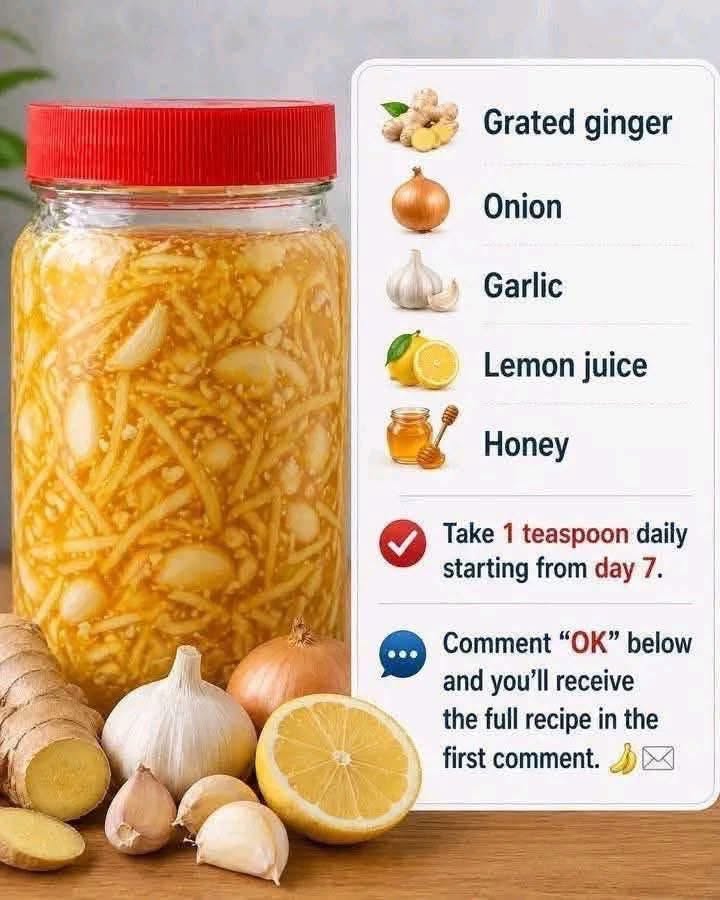
Lily went downstairs and found her grandmother in the kitchen. The table was covered with fresh ingredients: onions, garlic, ginger, lemons, and a jar of golden honey.
“Good morning, Grandma!” Lily said with a smile. “What are you preparing today?”
Her grandmother turned around and smiled warmly.
“Good morning, my dear. Today, I am preparing one of our family’s traditional recipes. It combines several familiar ingredients and is often used as a soothing addition to our routine during the cold season.”
Lily looked at the ingredients with curiosity.
“Onions, garlic, ginger, lemon, and honey? Together? That sounds unusual!”
Her grandmother laughed softly.
“It may sound unusual, but every ingredient has its own flavor and history. When they are combined, they create a strong, aromatic mixture that many people enjoy using in traditional home care.”
Lily pulled a chair toward the table.
“Please teach me how to make it. I want to learn the recipe so I can prepare it for our family.”
And so, their little adventure began.
Chapter Two: The Five Special Ingredients
Before starting the recipe, Grandmother Margaret explained that the first step was to understand the ingredients.
She picked up a medium-sized onion and placed it on the wooden cutting board.
“First, we have the onion,” she explained. “It has a strong smell and a distinctive flavor. People have used onions in cooking for thousands of years, and they are an important part of many traditional recipes.”
Lily carefully chopped the onion into small pieces. Her eyes began to water, and she started laughing.
“Grandma, this onion is making me cry!”
Her grandmother laughed too.
“That is one of the onion’s little secrets. Its natural compounds can irritate your eyes when you cut it.”
Next, Margaret took a small piece of fresh ginger. Its light brown skin covered a golden-yellow interior.
“Ginger has a warm, spicy flavor,” she said. “It is often used in teas, soups, and traditional recipes. Many people enjoy it in warm drinks, especially when they want something comforting.”
Lily grated the ginger into a small bowl. Its fresh, spicy aroma spread through the kitchen.
Then Grandmother Margaret picked up two cloves of garlic.
“Garlic has a powerful flavor and is widely used in cooking. It contains natural compounds that scientists continue to study, but we should not assume that eating garlic can prevent or cure every illness.”
Lily crushed the garlic carefully and added it to the bowl.
The fourth ingredient was a fresh lemon. Margaret cut it in half and squeezed the juice into a glass container.
The bright citrus smell filled the room.
“Fresh lemon juice adds a refreshing sour flavor,” she explained. “It also provides vitamin C, which is important for normal immune function.”
Finally, she brought out a small jar of raw honey. The honey glowed like liquid gold in the morning sunlight.
“Honey gives the mixture sweetness and helps balance the sharp flavors of the onion, garlic, ginger, and lemon,” Margaret said.
Lily dipped a clean spoon into the jar and tasted a little honey.
“It is delicious!”
Her grandmother smiled.
“Now you understand our five ingredients. Each contributes something different to the recipe, but remember that a traditional mixture is not a substitute for appropriate medical treatment.”
Lily nodded. She was ready to begin.
Chapter Three: Preparing the Golden Mixture
Grandmother Margaret washed her hands and cleaned the kitchen utensils. She explained that cleanliness was essential whenever someone prepared homemade food.
Lily gathered the ingredients and placed them on the counter.
Together, they measured one medium onion, one tablespoon of freshly grated ginger, two cloves of minced garlic, the juice of one lemon, and three to four tablespoons of honey.
First, Lily placed the grated onion in a clean bowl. She added the ginger and crushed garlic, then stirred the ingredients together.
The mixture had a strong smell, and Lily wrinkled her nose.
“It certainly smells powerful!” she exclaimed.
“Yes,” her grandmother replied. “That is why the honey and lemon are useful for balancing the flavors, although the mixture will still taste quite strong.”
Lily poured in the fresh lemon juice and stirred everything carefully.
Then she added the honey, one spoonful at a time, mixing until it coated the other ingredients.
The golden honey slowly blended with the juices released by the onion and ginger. The garlic remained visible in tiny pieces, while the lemon juice gave the mixture a glossy appearance.
When everything was combined, Margaret brought out a clean glass jar with a tight-fitting lid.
Lily carefully transferred the mixture into the jar.
“Is that all?” she asked.
“Almost,” her grandmother replied. “Now we cover the jar and place it in the refrigerator for several hours. This allows the flavors to blend together.”
Lily closed the lid and placed the jar on a refrigerator shelf.
She felt proud of herself. She had prepared a traditional recipe using simple ingredients from the kitchen.
While they waited, Grandmother Margaret reminded her that homemade mixtures containing fresh ingredients did not remain safe indefinitely. They would keep this batch refrigerated and use it within a short period, discarding it if they noticed anything unusual.
Lily wrote the preparation date on a small label and attached it to the jar.
“Being careful is part of cooking well,” Margaret said.
Lily agreed.
Chapter Four: The Smell That Filled the Kitchen
Several hours later, Lily returned to the kitchen. She opened the refrigerator and carefully took out the glass jar.
The mixture looked different from when she had first prepared it. Some liquid had collected at the bottom, and the honey had blended with the juices from the other ingredients.
Lily opened the lid and smelled the mixture.
The scent was strong, combining the sharp aroma of garlic, the warmth of ginger, the sweetness of honey, and the freshness of lemon.
“It smells even stronger now!” Lily said.
Her grandmother nodded.
“The ingredients have had time to mingle. That is one reason people allow traditional mixtures to rest before serving them.”
Lily placed the jar on the counter.
She wanted to understand why people used this recipe during the cold season. Her grandmother explained that many families had their own traditional preparations, passed from one generation to another.
Some people used honey to soothe a cough or irritated throat. Warm drinks could also feel comforting when someone had a cold.
However, Margaret emphasized an important point.
“Although honey may help soothe a cough for some people, we cannot promise that this mixture will strengthen someone’s immune system enough to prevent illness. It does not cure infections, and it should never replace medical care when that is needed.”
Lily listened carefully.
She realized that respecting traditional knowledge also meant understanding its limitations.
Her grandmother added that honey must never be given to babies younger than twelve months because of the risk of infant botulism.
Lily wrote the information in her notebook so that she would remember it.
The recipe was more than a combination of ingredients. It was also an opportunity to learn about food, safety, and responsible care.
Chapter Five: A Cold Day in the Village
A few days later, the temperature dropped, and a cold wind swept through the village.
Lily’s younger brother, Daniel, returned home from school wearing a thick coat and carrying his schoolbag over one shoulder.
“That wind is freezing!” he said as he entered the house.
He washed his hands, changed his clothes, and sat beside the fireplace.
Their mother prepared a warm meal, while Grandmother Margaret made a cup of warm lemon water with honey.
Daniel said that his throat felt scratchy and that he wanted something soothing to drink.
Grandmother Margaret prepared the drink carefully and let it cool to a comfortable temperature before serving it.
Lily remembered the golden jar in the refrigerator.
“Grandma, could we add some of our homemade mixture?”
Margaret considered the question before answering.
“The ingredients are foods we commonly use, but because the mixture is strong and contains raw ingredients, we should be thoughtful about whether it is suitable for Daniel. A simple warm drink with honey may be enough to soothe his throat.”
Daniel drank the warm honey and lemon water slowly.
Afterward, he wrapped himself in a blanket and rested.
Lily sat beside him and read a story about a young explorer who traveled through forests and mountains in search of hidden treasures.
Daniel smiled as she read aloud.
The family spent the evening together, sharing stories and enjoying the warmth of the house.
Lily realized that caring for someone was not always about finding a special remedy. Sometimes it meant preparing a comforting drink, offering company, and making sure the person had time to rest.
Chapter Six: The Neighbor’s Question
The next afternoon, their neighbor, Mrs. Rose, visited the house. She was an elderly woman who enjoyed gardening and often exchanged recipes with Grandmother Margaret.
When she entered the kitchen, she noticed the glass jar on the shelf.
“What is that golden mixture?” she asked.
Lily proudly explained how she had combined onion, ginger, garlic, lemon juice, and honey.
Mrs. Rose listened with interest.
“My mother used to prepare something similar,” she said. “She believed it helped her feel better during the winter.”
Lily smiled.
“Grandma taught me how to make it yesterday. I want to learn more about traditional recipes.”
Mrs. Rose nodded.
“Traditional recipes can be an important part of family culture. But we must be careful not to confuse a comforting food with a proven medicine.”
She explained that some ingredients had been studied for their possible health effects, but the evidence varied depending on the ingredient and the condition being discussed.
Lily asked whether the mixture could prevent colds.
Mrs. Rose shook her head gently.
“We cannot say that it prevents colds or guarantees stronger immunity. Good nutrition supports general health, but no single recipe can protect us from every infection.”
Grandmother Margaret agreed.
“That is why we teach our children to wash their hands, eat a balanced diet, get enough sleep, and seek medical advice when necessary.”
Lily wrote these ideas in her notebook.
She had expected to learn only a recipe, but every conversation was teaching her something new.
Chapter Seven: The Importance of Safety
As Lily became more interested in traditional recipes, she decided to create a small notebook containing instructions, ingredient lists, and safety reminders.
She gave the notebook a title: Nature, Food, and Family Wisdom.
On the first page, she wrote the recipe for the onion, ginger, garlic, lemon, and honey mixture.
Underneath the instructions, she added several important notes.
The mixture should be prepared using clean utensils and stored in a clean, covered container in the refrigerator.
Because it contains fresh ingredients and has not been professionally tested or preserved, its exact safe storage life cannot be guaranteed simply by following a traditional recipe.
Lily decided to prepare small batches and avoid keeping them for long periods. She would discard the mixture if she noticed mold, an unusual smell, or other signs of spoilage.
She also wrote that people with allergies to any of the ingredients should avoid the mixture.
Honey was not suitable for babies younger than twelve months. People with medical conditions or those taking medication should ask a qualified healthcare professional if they were unsure whether a concentrated homemade preparation was appropriate for them.
Finally, she wrote in large letters:
“A homemade remedy can be comforting, but it is not a substitute for medical treatment.”
When Grandmother Margaret read the notebook, she was delighted.
“You are learning to combine tradition with careful thinking,” she said.
Lily felt proud.
She wanted to preserve her family’s knowledge while making sure that anyone who used the recipes understood their limitations.
Chapter Eight: A Lesson at the Village School
One week later, Lily’s teacher announced a special school activity about traditional food and family customs.
Each student was invited to present a recipe that had been passed down through their family.
Lily immediately thought about the golden jar.
She prepared a short presentation describing the ingredients, the preparation process, and the story of learning the recipe from her grandmother.
On the day of the activity, she stood in front of the class with her notebook.
“Today, I want to share a traditional mixture made from onion, ginger, garlic, lemon juice, and honey,” she began.
She explained how the ingredients were combined in a clean bowl and transferred to a covered glass jar for refrigeration.
She described the mixture’s strong flavor and explained why some families traditionally used honey in soothing drinks during the cold season.
Then she paused and looked at her classmates.
“I also learned something important,” she continued. “Just because a recipe is natural or has been used for many years does not mean that it can cure every illness.”
The classroom became quiet.
Lily explained that traditional recipes could be meaningful parts of family life, but medical claims needed reliable evidence.
Her teacher smiled approvingly.
“Excellent work, Lily. You have shown us both the cultural importance of traditional knowledge and the importance of responsible thinking.”
After the presentation, several students asked questions about the ingredients.
Lily answered as carefully as she could. When she did not know the answer, she admitted it rather than inventing information.
Her teacher later told her that honesty was one of the most important qualities a learner could develop.
Lily returned home feeling confident and happy.
Chapter Nine: The Golden Jar and the Family Tradition
As winter continued, Lily and her grandmother spent more time together in the kitchen.
They prepared soups, baked bread, made herbal teas, and experimented with different combinations of fruits and vegetables.
Lily discovered that cooking was not simply about following instructions. It was about understanding ingredients, learning from mistakes, and sharing experiences with others.
The golden jar remained one of their most memorable projects because it reminded Lily of the day she began asking questions about traditional remedies.
She learned to appreciate ginger for its distinctive warmth, lemon for its bright flavor, garlic and onion for their role in cooking, and honey for its sweetness.
She also learned that a mixture containing these ingredients did not automatically become a scientifically proven immune booster.
Whenever relatives visited, Lily shared the story of the recipe rather than promising that it would prevent illness.
Some family members enjoyed the strong flavor, while others preferred ordinary honey and lemon water.
Everyone had different tastes, and Lily understood that there was no need for everyone to follow the same routine.
One evening, Grandmother Margaret gave Lily a small, empty glass jar.
“This is for your collection,” she said.
Lily held it carefully.
“Why an empty jar, Grandma?”
Margaret smiled.
“Because it reminds you that the most important ingredient in any recipe is not always something you can measure. It can be patience, care, knowledge, and the willingness to learn.”
Lily hugged her grandmother.
She knew that she would remember those words for the rest of her life.
Chapter Ten: The True Meaning of Natural Wellness
Years passed, and Lily grew into a confident young woman who loved sharing knowledge about food, gardening, and healthy habits.
She never forgot the lessons she had learned in her grandmother’s kitchen.
She understood that taking care of oneself involved many ordinary but important actions: eating a varied and balanced diet, drinking enough fluids, getting sufficient sleep, maintaining good hygiene, and seeking appropriate medical care.
She also understood that traditional remedies could offer comfort without necessarily treating the underlying cause of an illness.
The golden mixture of onion, ginger, garlic, lemon juice, and honey remained a symbol of her family’s traditions. Whenever she prepared it, she remembered the sound of her grandmother’s voice, the smell of fresh ginger, and the warmth of their little kitchen on a cold morning.
One day, Lily was asked to speak at a community gathering about the importance of preserving family traditions.
She stood before the audience and told them the story of the golden jar.
“At first, I thought I was learning a special recipe,” she explained. “But I discovered something much more valuable. I learned that we can respect the wisdom of previous generations while still asking questions and checking whether health claims are supported by evidence.”
The audience listened closely.
Lily continued, “Nature provides us with many wonderful foods, and traditional recipes can bring families together. But caring for our health also means understanding risks, recognizing our limits, and knowing when to seek professional advice.”
When she finished speaking, the audience applauded.
Lily returned home that evening and visited her grandmother’s old garden. The sun was setting, and the last golden rays illuminated the flowers and trees.
She stood quietly for a moment, remembering everything she had learned.
Then she smiled.
The secret of the golden jar had never been that it could cure every illness or protect everyone from winter colds. Its true value was the way it brought her family together, encouraged curiosity, and taught her to combine tradition with knowledge.
And so, Lily continued her journey, sharing recipes, asking questions, and learning something new every day.
The End.
Moral of the Story
Traditional recipes can connect generations and provide comforting foods and drinks. However, natural ingredients are not guaranteed cures for illness. True wellness comes from balanced nutrition, good daily habits, safe food preparation, reliable information, and appropriate medical care when needed.